

Tax Credit for Research, Innovation and Commercialization (CRIC)

Because the CRIC Quebec program is brand new, start with a quick expert check before you file. Contact our PhD-level team and partner accounting firms for a no-obligation eligibility review. We will assess your projects, map eligible expenses, and explain how CRIC stacks with federal SR&ED. Ask us to walk you through both programs. Prefer self-research first? See our SR&ED page for the federal component.

CRIC Tax Credit

Let’s talk

What is the CRIC program?

CRIC Québec—the tax Credit for Research, Innovation and Commercialization is the province’s new, fully refundable incentive for corporations that carry out eligible R&D and pre‑commercialization work in Québec. It applies to corporate taxation years beginning after March 25, 2025, with a prescribed form to be filed with the income tax return as part of Québec’s tax return.

This program replaces eight legacy provincial innovation measures (including various R&D wage/design credits and tax holidays for foreign experts) to simplify the regime and refocus support. It is designed to complement and not replace the federal SRED program: companies can continue to claim SRED for qualifying R&D while using CRIC Québec for R&D and newly eligible pre‑commercialization and R&D equipment costs, subject to coordination rules.

Why the new CRIC tax credit?

The government of Québec designed CRIC to:

  • Simplify and consolidate incentives under one set of rules and one filing
  • Broaden what is eligible including pre‑commercialization and R&D equipment
  • Boost early dollars invested with the higher rate now granted to all companies
  • Stay complementary to federal SR&ED (you can still stack, with usual coordination rules)

Note: CRIC amounts cannot be double‑claimed with other Quebec credits, and any government or non‑government assistance reduces qualified expenditures.
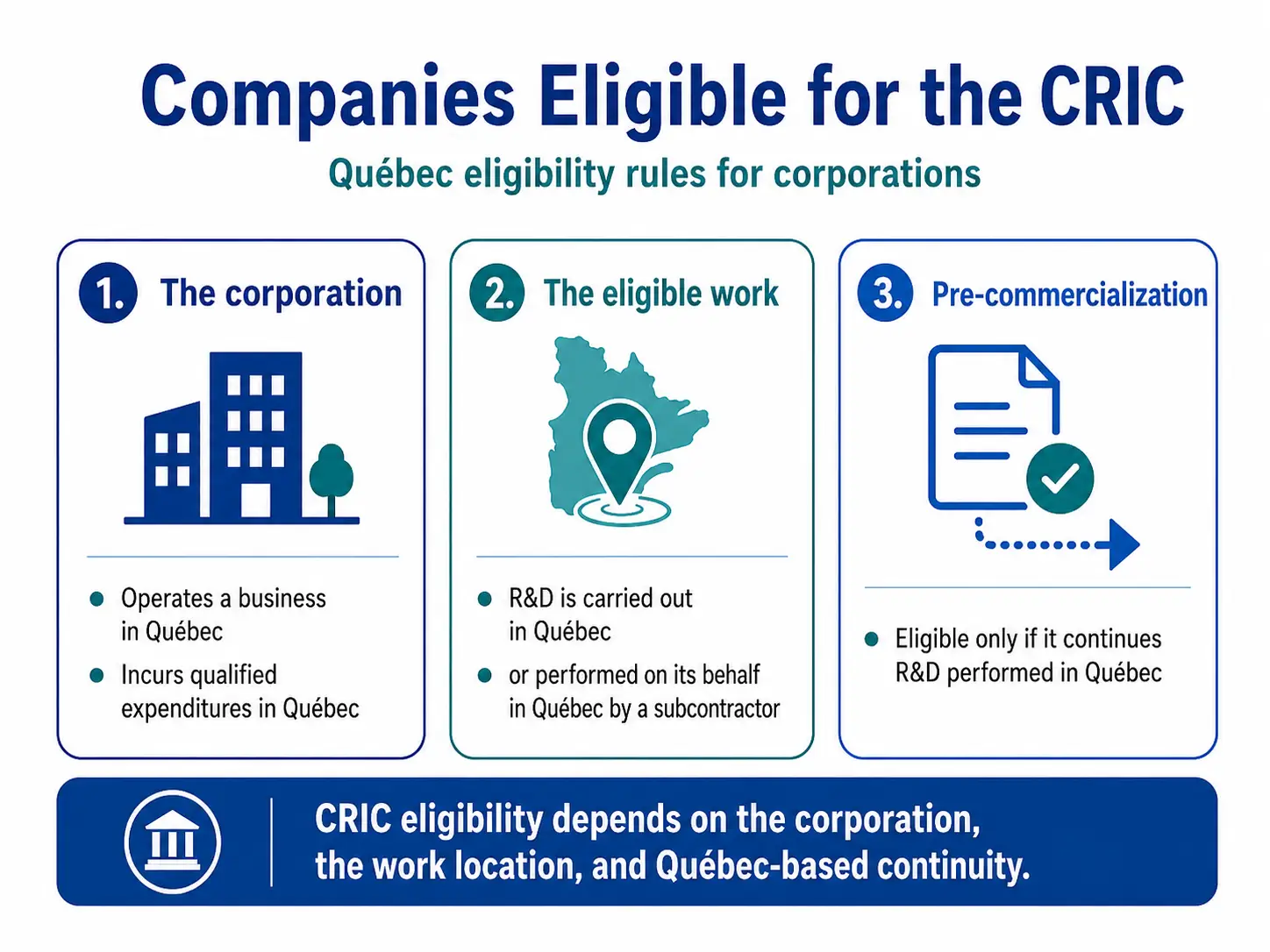
Companies eligible for the CRIC

To claim the CRIC tax credit, a corporation must:

  • Operate a business in Quebec and
  • Carry out eligible R&D or pre‑commercialization in Quebec (or have it carried out on its behalf in Quebec by a subcontractor)

Additionally, pre‑commercialization must be a continuation of R&D performed in Quebec by the corporation or on its behalf, and qualified expenditures must be incurred in Quebec.

What this means in practice

  • “On its behalf” is not just a paper contract: the work itself must be performed in Québec (including subcontract work) to count.
  • Pre‑commercialization is post‑R&D work like tests/validations for certifications and product design, but only when it directly continues Québec‑performed R&D. Expect Revenu Québec to verify the continuity with prior Québec R&D, timesheets, and subcontract evidence.

A tricky non‑eligible example

A Quebec corporation develops its core technology entirely outside Quebec (e.g., in Ontario or abroad). It then performs pre‑commercialization steps (certification tests, product design) in Quebec and tries to claim CRIC for those steps. Not eligible.

Why? The law requires pre‑commercialization to be undertaken in conjunction with R&D carried out in Quebec. Because the underlying R&D was not conducted in Quebec, the pre‑commercialization work fails the continuity requirement even though it happened in Quebec.

Tip: If any part of the supply chain (R&D or pre‑commercialization) is subcontracted, make sure the work location is in Québec and your files clearly show the Québec‑based continuity from R&D to pre‑commercialization.

What are the activities eligible for the CRIC ?

R&D activities follow the harmonized federal definitions:

  • Basic research (new knowledge)
  • Applied research (knowledge with a practical aim)
  • Experimental development (technological advancement with new or improved products, devices, materials, or processes)
  • The CRA continues to perform the scientific review for SRED

Pre‑commercialization activities eligible for the CRIC

Eligible pre‑commercialization includes (CRIC Québec):

  • Tests, technological validations, and studies performed to meet regulatory approvals/certifications
  • Product design (form, functionality, materials selection). These activities must be a continuation of R&D carried out in Québec by your corporation or on its behalf

Concrete examples (typical cases)

Competitive analysis of products on the market, evaluation of operational constraints, prototype development, validation by pilot users, regulatory compliance verification (e.g., health), and development of usage scenarios (use cases), where these activities are carried out directly as a continuation of R&D performed in Quebec (including subcontracted work).
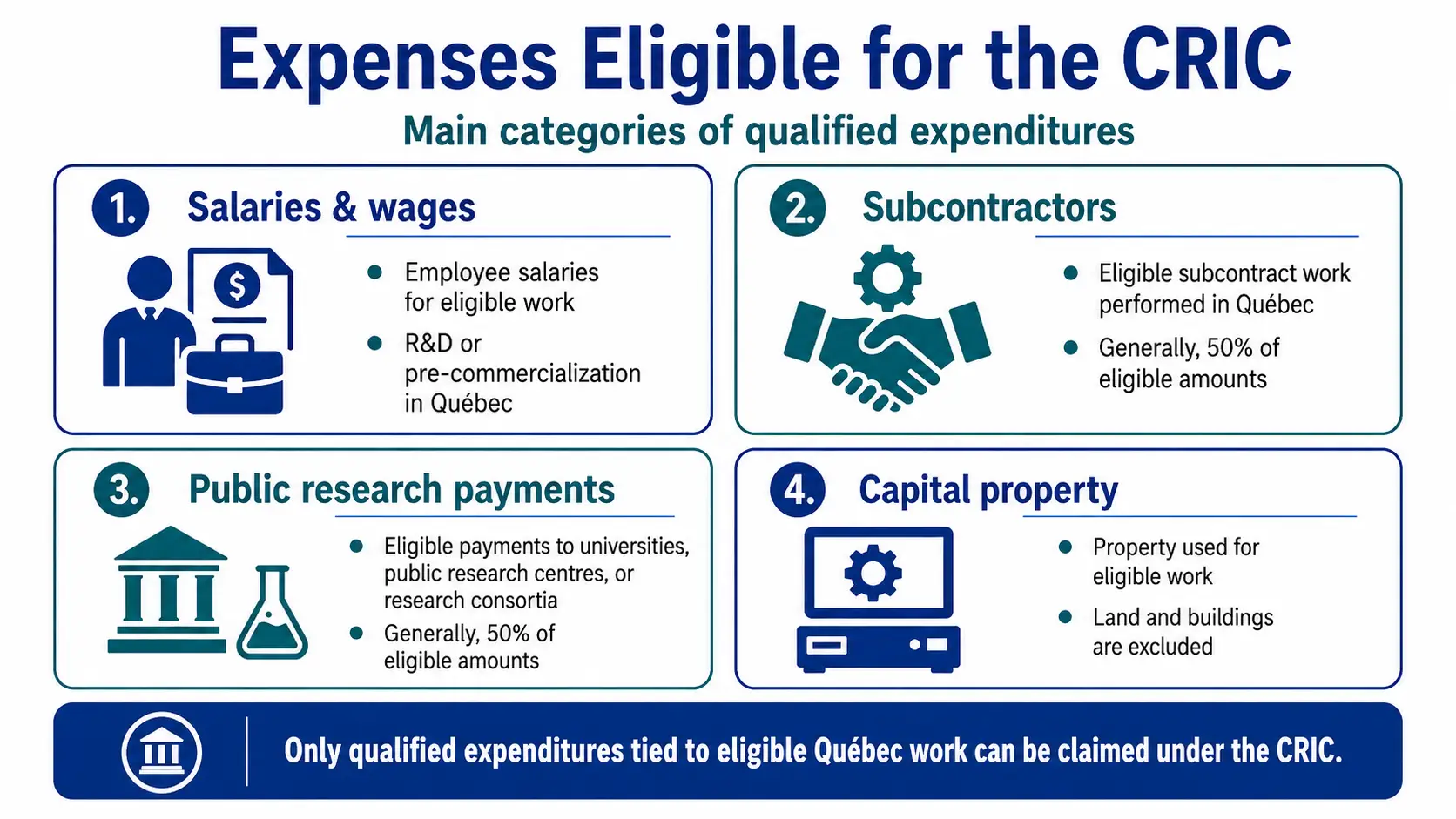
Which expenses are eligible for the CRIC ?

Qualified expenditures (incurred in Quebec) include:

  • Salaries/wages of employees on eligible work
  • 50% of payments to a Quebec subcontractor
  • 50% of payments to an eligible public research center, research consortium, or university entity
  • Capital property acquisition costs used for eligible work (excluding land, buildings, or rights to use them)

CRIC tax credit rates

The basic rate is 30% on the first $1M above the exclusion threshold, then decreases to 20% above the first $1M, regardless of the value of corporate assets.

Range Rate How it applies
First $1M of qualified expenses X 30% Applies to both R&D and pre‑commercialization
Excess over $1M X 20% All refundable credit; no asset‑size test
Exclusion threshold per employee $18,952 Portion of each employee’s salary that is not eligible for the credit. Basic personal amount for 2026, increasing every year.

Exclusion threshold for the CRIC

You must first exceed the greater of:

  • $50,000 or
  • The sum of the basic personal amount (BPA) for each employee, prorated by their time on eligible R&D + pre‑commercialization. For 2026, Quebec’s BPA is $18,952 per employee.

Example:

A team has 5 employees earning $80,000 each, averaging 75% of their time on R&D eligible work. The employee-based threshold is 5 X 75% X $18,952 = $71,070 (which is greater than $50,000).

With qualified expenditures of $300,000 (= 5 X $80,000 X 75%), the CRIC base is $300,000 − $71,070 = $228,930, and the credit X 30% = $68,679.

If we multiplied that team by 5 to reach 25 employees instead, the qualified expenditures would reach $1.5 M – (25 X $18,952) = $1,144,650 and the credit would be 30% on the first $1M + 20% on the rest : $1M X 30% + 144,650 X 20% = $328,930.
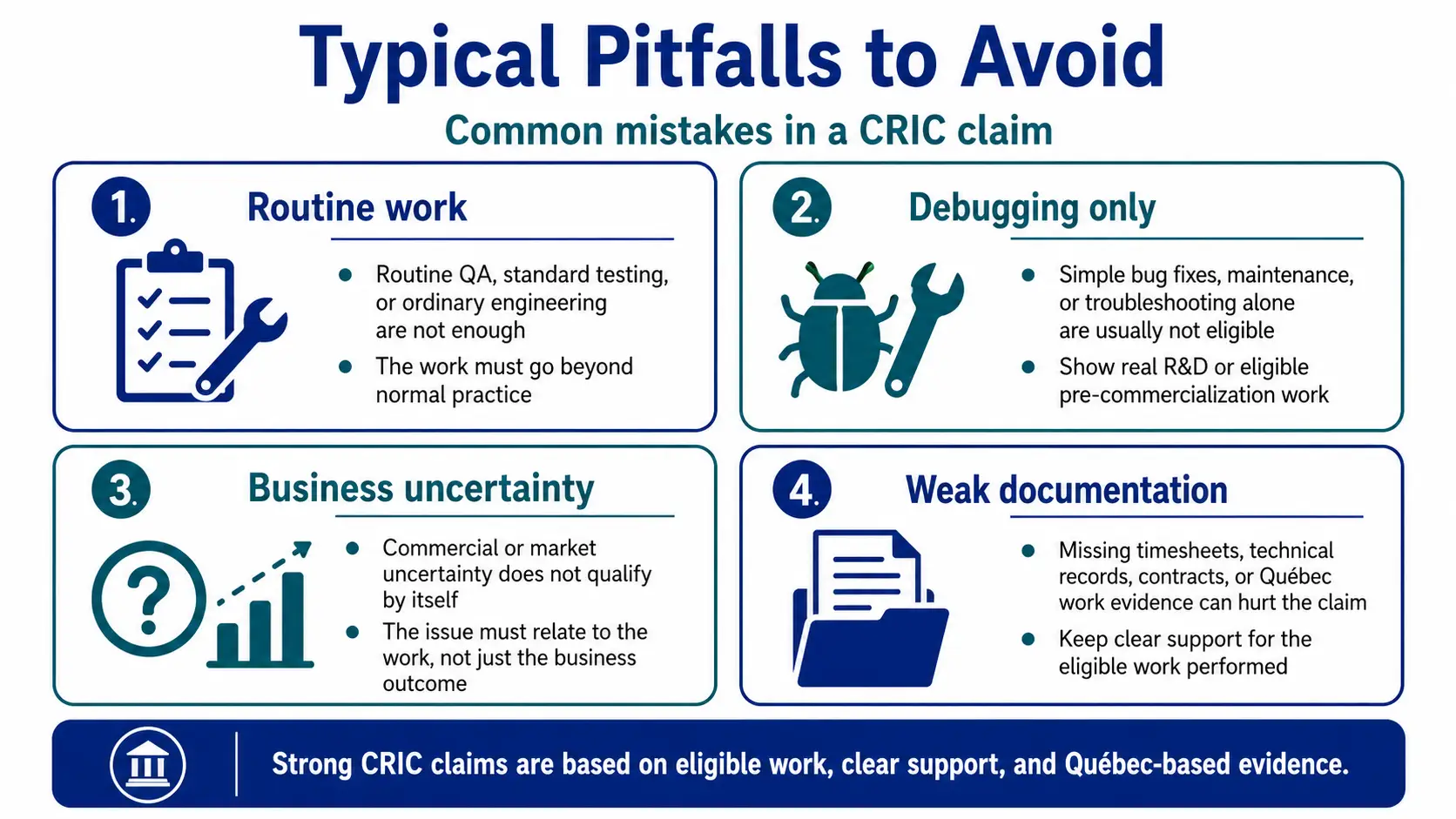
Typical pitfalls to avoid

  • Confusing business or market uncertainty with technological uncertainty
  • Treating debugging, maintenance, or routine quality assurance as experimental development
  • Claiming integration/customization without showing a technological advancement
  • Missing the chain “hypothesis → experiment → evidence” CRA expects in claims and reviews
  • Blurring boundaries between R&D and pre‑commercialization, which can misallocate costs between SR&ED and CRIC Québec

How our PhD experts set you up for success

  • Pre‑claim design: structure work packages and experiments that meet SRED/CRIC criteria
  • Eligibility mapping: separate eligible R&D from routine work and from pre‑commercialization
  • Documentation tooling: templates for hypotheses, trials, results, and time tracking tied to activities
  • Claim optimization: coordinate SR&ED (federal) with CRIC Quebec (provincial) so you capture and optimize all eligible costs
  • Review readiness: align project narratives and evidence to the way CRA conducts the scientific review for R&D, reducing friction at audit

Bottom line: The definitions are shared and look simple, but interpretation is nuanced. With expert design up front, you protect your SRED and maximize your CRIC Quebec claim.

Get a second opinion

Unsure whether your work qualifies for tax credits or pre‑commercialization under CRIC Quebec? Call 514‑765‑3333 or email info@emergex.com for a clear, second opinion and a deeper explanation tailored to your projects.

We regularly support projects in experimental development, artificial intelligence (AI), and complex software. We also partner with accounting firms when needed to align tax and technical narratives.

Ask us anything!

CRIC Tax Credit FAQ

The CRIC tax credit is provincial (Québec) and fully refundable; it covers R&D and now pre‑commercialization and capital equipment used for eligible work. The federal SR&ED program remains separate and focuses on R&D work only. Québec explicitly designed CRIC to be complementary to federal SR&ED: wages supporting R&D can generally be stacked, while CRIC claims for pre‑commercialization or equipment do not reduce federal SR&ED (since those categories are not federally eligible). You cannot claim the same Québec expenditure under CRIC and another Québec credit.

Three stand out for CFOs and CTOs:

  • Breadth—It now recognizes tests/validations for approvals, product design, and capital property, supporting the journey from lab to market.
  • Higher early-dollar support—30% on the first $1M above the threshold, then 20% beyond, with refundability helping cash flow even if you owe no tax.
  • Simplification—CRIC consolidates eight programs into one, reducing fragmentation and aligning with federal definitions (CRA scientific review).

Net-net, CRIC widens the possibility of eligible expenses and streamlines administration, while keeping room to stack with federal SR&ED where permitted.

Plan in three steps:

  • Scope & track—map eligible R&D and pre‑commercialization, implement granular time tracking (to compute the exclusion threshold), and segregate qualified expenditures (wages, 50% subcontracts, eligible equipment).
  • Compile support—technical narratives (obstacles met, advancement sought and systematic investigation), test/validation evidence, contracts/invoices, and capital assets documentation.
  • File—complete the prescribed CRIC form (to be released by the Ministère des Finances) and attach it to your corporate return for fiscal years beginning after March 25, 2025.

Revenu Quebec has indicated internal preparation is underway; detailed communications are expected as implementation proceeds.

Evidence What to include (short) Why it matters
Timesheets Monthly per-employee % time on eligible work Drives eligible expenses and the CRIC exclusion threshold.
Technical R&D memo Hypothesis → Experiments → Results (1–2 pages) Proves systematic investigation and supports SR&ED + CRIC tax credits.
Pre-commercialization proof Test plans, validation reports, product design files (link to R&D work) Shows continuity from Quebec R&D — key for CRIC eligibility.
Contracts & invoices Subcontractor SOWs, invoices stating “work performed in Quebec” Verifies the paid work location and the portion eligible for the refundable tax credit.

Want us to check your file and spot every dollar that is eligible for tax credits (CRIC + SR&ED)? Get a quick, no-nonsense second opinion. We will show you exactly what to document and how to maximize your refundable tax credit.

The government has confirmed CRIC’s start date and that the form will be available in 2025, but it has not published specific turnaround times. In a new program’s first year, agencies typically tighten reviews—especially where pre‑commercialization is newly eligible—so expect longer processing at first. Revenu Quebec has communicated that preparatory work and guidance roll‑outs are ongoing; practitioners should plan for deeper verification (e.g., timesheets, subcontract evidence, etc.) and possible delays during ramp‑up. Build timelines accordingly and maintain audit-ready files.

First page call to action

Book a free consultation

Contact us

We proudly support Québec companies in maximizing the new CRIC refundable tax credit. Benefit from over 30 years of expertise in R&D tax credits by getting our expert opinion on your past, current, and upcoming CRIC claims. Let us help you identify eligible expenses and ensure your claim is fully optimized and compliant.