
SRED square

What is your experience with SR&ED tax credits?

As a consulting company active throughout Canada for over 25 years in R&D tax credits, known as the SR&ED tax credit program, Emergex helps you optimize your claims. From planning and preparation to audit defense and coaching, our team of experts delivers some of the most trusted SR&ED services in the industry. Several Canadian government initiatives support research and development, and among them, the SR&ED tax credit program is the most significant. This incentive covers a wide range of eligible work in science and technology — meaning you could already be doing SR&ED without even knowing it.

SR&ED Tax Credit

Let’s talk

What is the SR&ED tax credit?

The Scientific Research and Experimental Development (SR&ED) tax credit is one of the largest government incentive programs supporting innovation in Canada. The program  encourages businesses to invest in research and development (R&D) by providing tax credits or refunds for eligible activities and expenses.

Administered by the Canada Revenue Agency (CRA), the SRED program helps companies recover a significant portion of the costs associated with developing new technologies, improving existing products, or creating more efficient processes. With $4 billion in tax benefits awarded each year, it is the largest tax initiative of its kind.

The SR&ED tax credit can significantly reduce the cost of developing innovation. Eligible companies may receive refundable or non-refundable tax credits for expenses such as employee salaries, contractor fees, materials, equipment, and overhead costs related to R&D projects.

Who can claim SRED tax credits

The SR&ED program is available to many types of businesses operating in Canada that conduct eligible research and development activities. The program supports companies working to create new technologies, enhance existing products, or develop innovative processes.

According to the Canada Revenue Agency, several types of organizations may be eligible to claim the SR&ED tax credit, including, by decreasing order of financial benefit:

  • Canadian-controlled private corporations (CCPCs)
  • Public corporations operating in Canada
  • Foreign-owned companies performing R&D in Canada
  • Partnerships conducting eligible R&D activities
  • Individuals running eligible research projects

Canadian-controlled private corporations often receive the most generous benefits, as they may qualify for larger and refundable tax credits on eligible expenditures. SRED eligibility can provide significant financial support for startups and small businesses investing in innovation.

Eligible SRED activities

To qualify for the SR&ED tax credit, a project must involve research and development activities that aim to achieve a technological advancement. According to the Canada Revenue Agency, SRED tax credit eligibility requires systematic investigation or experimentation to resolve technological uncertainties.

The program recognizes three main categories of eligible activities:
  • Basic Research : Experimental or theoretical work undertaken primarily to gain new scientific knowledge without a specific practical application in mind.
  • Applied Research : Research conducted to advance scientific knowledge with a specific practical objective or application.
  • Experimental Development : Work undertaken to achieve technological advancement by developing new technologies, products, or processes, or by improving existing ones.

Examples of SRED eligible activities

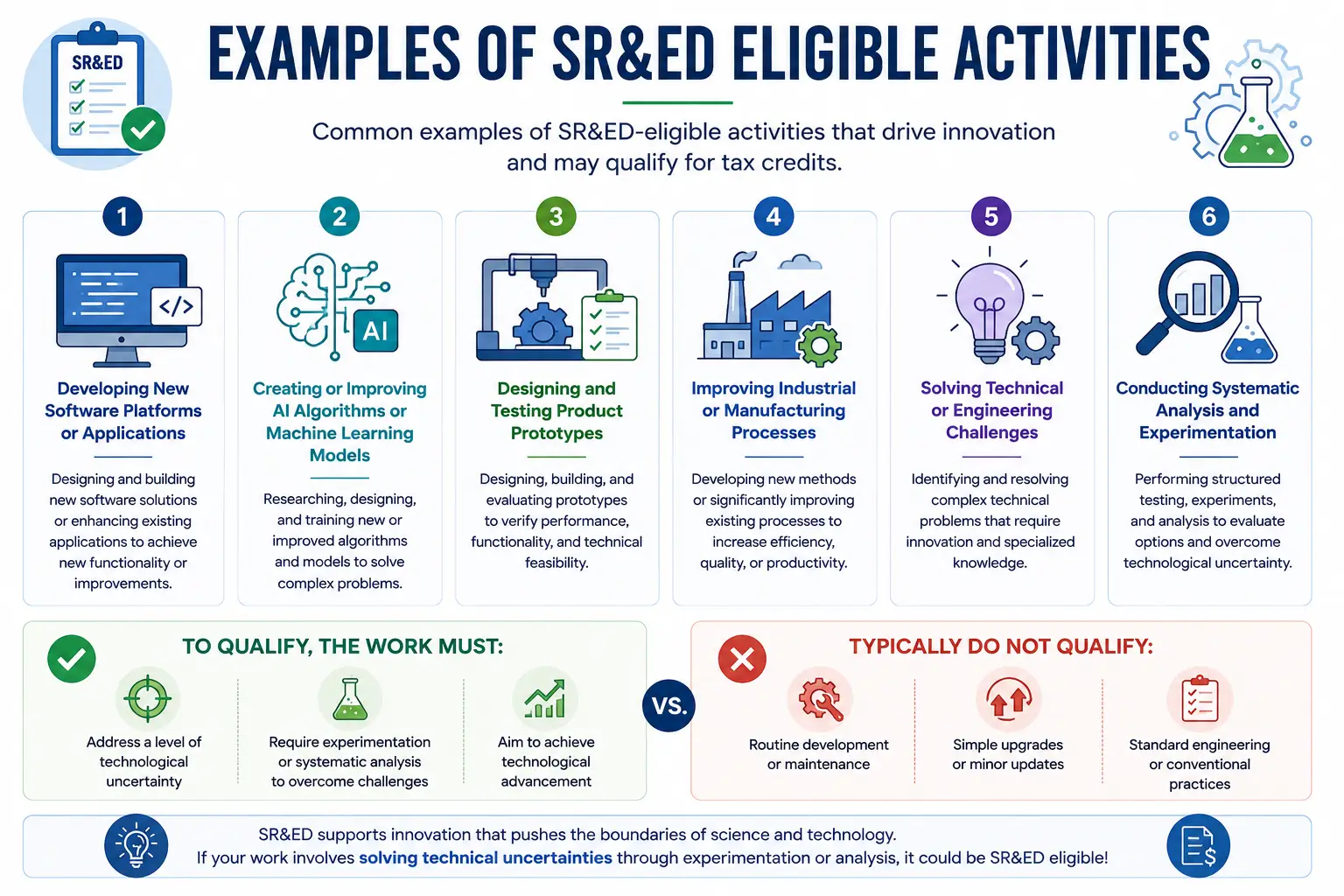
Common examples of SR&ED-eligible activities include:

  • Developing new software platforms or applications
  • Creating or improving AI algorithms or machine learning models
  • Designing and testing product prototypes
  • Improving industrial or manufacturing processes
  • Solving technical or engineering challenges
  • Conducting systematic analysis and experimentation

To qualify, the work must involve a level of technological uncertainty and require experimentation or analysis to overcome technological challenges. Routine development, simple upgrades, or standard engineering work typically do not qualify under the SR&ED program.

What can your business earn

Through the SRED program, your company may receive one or both of the following:

  • A refundable tax credit that first reduces your income tax payable to zero, with any surplus refunded to you in cash. Think of it this way: first you eliminate your tax bill, then you actually get money back.
  • A non-refundable tax credit to reduce your income tax burden, with unused credits carried back for up to three years or forward for up to 20 years.

To achieve a successful claim, it is essential to maintain detailed records of your work and understand the eligibility requirements under the Income Tax Act.

How to calculate SRED tax credit

Calculating your SR&ED tax credit begins by identifying eligible expenditures such as wages, contractor fees, materials, equipment, and overhead directly related to your R&D activities.

Next, determine your organization type, as Canadian-controlled private corporations (CCPCs) can access higher refundable rates, while other companies receive lower, non-refundable credits. You then apply the federal rate up to 35% for CCPCs on the first $6 million, or 15% for others—and add any applicable provincial credits.

Accurate calculation is key to maximizing your claim while staying compliant with CRA requirements.

To learn more about this, read our complete guide on how to calculate your SRED claim step by step.
How to claim your SR&ED tax credit

Claiming the SRED tax credit requires submitting detailed project summaries to the Canada Revenue Agency along with your corporate income tax return. Accurate record-keeping and a well-prepared claim are essential for approval.

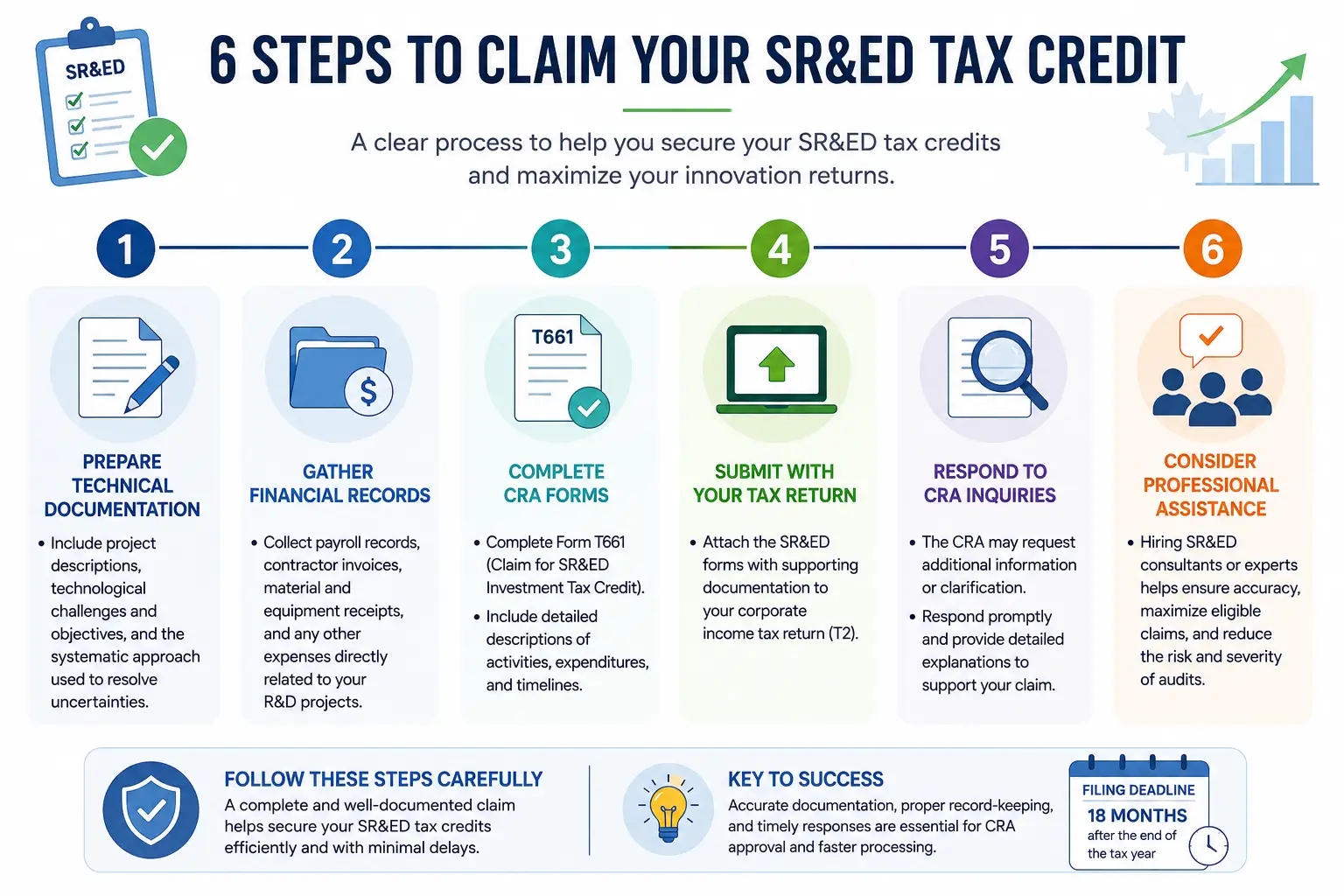
Steps to claim your SRED tax credit:

1. Prepare technical documentation

Include project descriptions, technological challenges and objectives, and the systematic approach used to resolve uncertainties.

2. Gather financial records

Collect payroll records, contractor invoices, material and equipment receipts, and any other expenses directly related to your R&D projects.

3. Complete CRA forms

  • Form T661 (Claim for SR&ED Investment Tax Credit)
  • Include detailed descriptions of activities, expenditures, and timelines.

4. Submit with your tax return

Attach the SRED forms with supporting documentation to your corporate income tax return (T2).

5. Respond to CRA inquiries

The CRA may request additional information or clarification. Respond promptly and provide detailed explanations to support your claim.

6. Consider professional assistance

Hiring SRED consultants or experts help ensure accuracy, maximize eligible claims, and reduce the risk and severity of audits.

Following these steps carefully can help secure your SR&ED claim efficiently and with minimal delays.
Common SRED claim mistakes

Even experienced businesses can make errors when preparing an SR&ED claim. Avoiding common pitfalls can help ensure your claim is approved and maximize the tax credit you receive.

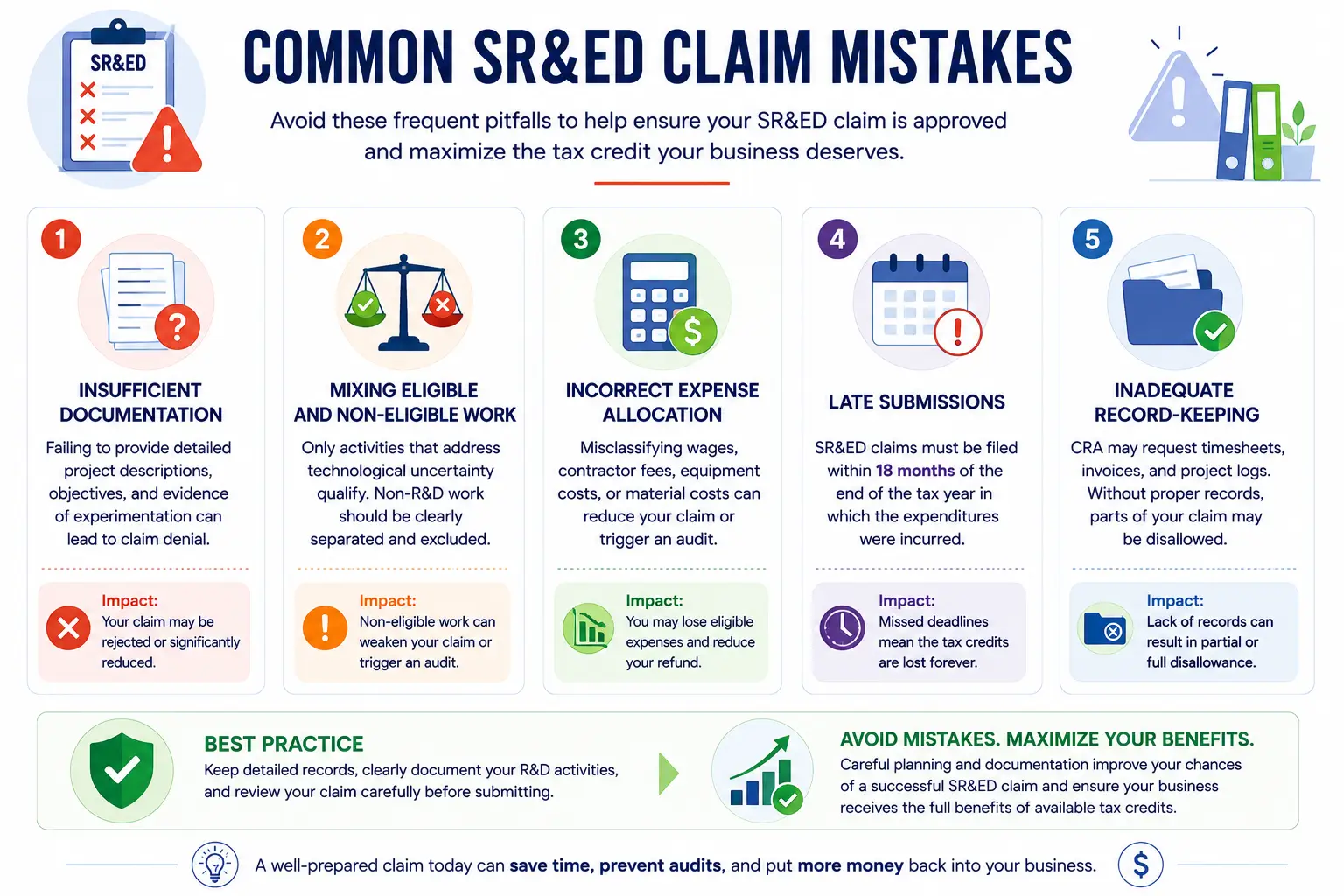
Here are some frequent mistakes to watch out for:

  • Insufficient documentation : Failing to provide detailed project descriptions, objectives, and evidence of experimentation can lead to claim denial.
  • Mixing eligible and non-eligible work : Only activities that address technological uncertainty qualify. Non-R&D work should be clearly separated and excluded.
  • Incorrect expense allocation : Misclassifying wages, contractor fees, equipment costs, or material costs can reduce your claim or trigger an audit.
  • Late submissions : SRED claims must be filed within 18 months of the end of the tax year in which the expenditures were incurred. Otherwise, the tax credits are lost forever.
  • Inadequate record-keeping : CRA may request timesheets, invoices, and project logs. Without proper records, parts of your claim may be disallowed.

By avoiding these mistakes, you can improve your chances of a successful SR&ED claim and ensure your business receives the full benefits of available credits.

How to optimize your SRED refunds with Emergex

Emergex support you in every phase of your SR&ED claim, from identifying eligible activities to preparing your audit defense. Our consultants ensure full compliance and are particularly experienced with IT and software development projects. Our goal is to help you maximize returns while minimizing audit risks.

Claim the SRED investment tax credit

Since 1994, we have helped over a thousand clients claim SR&ED credits with a 98% success rate. Our experts:

  • Identify activities and expenses potentially eligible for SRED
  • Validate SRED eligibility
  • Prepare documentation for your claim
  • Assist with SR&ED audits and escalate if necessary

Our team ensures your qualified expenditures meet the CRA’s strict standards.

Consulting and training

We do not just fill out forms. Emergex also provides:

  • Strategic planning for your SRD incentives
  • Employee training to identify and document SRED work
  • Workshops on technological, financial, fiscal, and legal aspects of SR&ED
  • Long-term optimization of revenues for claimants

Optimization

Beyond SR&ED, we help you leverage other federal and provincial tax credits such as CDAEIA program, digital media, and multimedia programs. We also assist with grants like IRAP, the Industrial Research Assistance Program. Our goal is to create an optimized mix of incentives that offsets costs and supports growth.

SRED financing

Need liquidity before receiving your credits? Emergex helps you:

  • Access prefinancing with letters of comfort recognized by banks and private lenders
  • Connect with partners in tax credit financing
  • Prepare files aligned with CRA’s technical and financial criteria

98%

Historical success rate

25+

Years of experience

110 %

Maximum refund with SR&ED and IRAP combined

74 %

Maximum tax refund on eligible expenses

5 000

Companies claim SR&ED every year in Canada

SR&ED FAQ

Working with a consultant is highly recommended, especially if you want to maximize your SR&ED tax credit while minimizing the risk of rejection. The Canada Revenue Agency (CRA) frequently updates its guidance on technological uncertainty, systematic investigation, experimental development, and technological advancement.

A skilled SRED consultant ensures your documentation accurately reflects qualified SR&ED work, supports your tax credit claim, and prepares you for potential CRA reviews or audits.

Firms like Emergex combine technical, financial, fiscal, and legal expertise to guide you through the entire claim cycle, from identifying eligible SR&ED activities to submitting a compliant and optimized claim—making their multidisciplinary team your best ally for success.

The rates vary depending on the type of business and your eligibility under the Income Tax Act.

  • Canadian-controlled private corporations (CCPCs) can claim a refundable tax credit at an enhanced rate of 35% on up to $6 million in qualified SR&ED expenditures from the federal. Provinces contribute at different rates in addition to this 35%.
  • Expenditures exceeding this threshold qualify for a 15% non-refundable tax credit.
  • Other corporations (non-CCPCs) are eligible for a 15% non-refundable investment tax credit.
  • Individuals and trusts may qualify for a 15% refundable credit.
  • Partnerships are not eligible for the SR&ED tax credits.

The SR&ED tax credit program is the most generous incentive for research and development in Canada, allowing companies to reinvest in innovation and reduce financial risk.

To maximize your SR&ED tax incentives, it is essential to identify all qualified expenditures incurred during the fiscal year, including wages, subcontractor fees, materials consumed, R&D equipment, and overhead.

Keeping detailed records of your work, such as technical reports and timesheets, ensures compliance with CRA eligibility requirements. Working with experienced SR&ED consultants helps ensure your claimant profile is strong, your file is complete, and your submission aligns with CRA review expectations. The more thorough your documentation, the stronger your claim.

In the event of an audit, the CRA may request additional documentation or clarification regarding your claim. Working with SRED consultants can help you navigate the audit process and ensure your claim remains compliant with all CRA guidelines.

If the claim is not selected for review or audit, the Canada Revenue Agency typically processes it within 60 days or less. In cases where the claim is selected for review, the process generally takes up to 180 days, depending on the complexity of the file and the completeness of the documentation provided.

Yes, startups are eligible for the SR&ED tax credit, even if they are not yet generating revenue. An SRED application can provide crucial funding for early-stage research and development projects, helping startups accelerate innovation and growth.

First page call to action

Book a free consultation

Contact us

We are proud to be a trusted partner for companies across Canada looking to leverage SR&ED, other tax credits and grants. Benefit from our quarter of a century of experience by asking our opinion about your past, present and future claims!